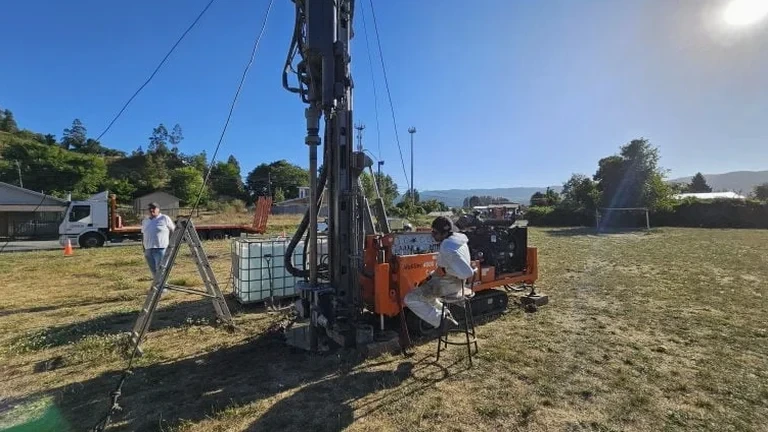
Dallas County sits on the Eagle Ford Shale and Austin Chalk contact, with extensive alluvial terrace deposits along the Trinity River. Groundwater in the floodplain is often within 8 feet of surface after spring rains. An exploratory test pit provides direct access for logging these transitions. The method helps identify fill thickness and seasonal water table elevation. For correlation with depth-dependent strength parameters, the project may require SPT drilling to obtain split-spoon samples at target intervals below the pit floor.
Direct observation of stratification eliminates interpretation errors that remote sensing methods cannot fully resolve in layered formations.
Method and coverage
Site-specific factors
Dallas recorded a magnitude 3.6 earthquake in 2022, centered near Irving. While not a high-seismicity zone, the city's expansive clay formations pose a year-round risk. Shallow utilities and old brick sewers fail when the soil heaves. An exploratory test pit reveals the active zone depth. The engineering team measures moisture content at 1-foot intervals to map the wetting front. Failing to log the fill-formation contact leads to differential heave and slab distress. The pit inspection confirms whether the subgrade supports the design bearing capacity or requires lime treatment.
Relevant standards
ASTM D2488 - Visual-Manual Soil Description, ASTM D420 - Site Characterization, OSHA 1926 Subpart P - Excavation Safety
Related services
Stratigraphic Logging and Sampling
Wall mapping and photographic log of each stratum. Bulk and block samples for laboratory index testing. Water table measurement recorded on-site.
Fill Evaluation and Shrink-Swell Assessment
Identification of undocumented fill layers. Moisture content profiling at 1-foot intervals for potential vertical movement calculation.
Typical parameters
Quick answers
How deep can an exploratory test pit go in Dallas clay?
Standard depth reaches 14 feet with a 24-inch wide excavation. Deeper pits require stepped benching per OSHA 1926 Subpart P. The Eagle Ford shale often limits practical depth without a rock hammer.
What is the cost range for a test pit in Dallas?
A single exploratory test pit typically runs between US$520 and US$850. The final figure depends on access conditions, depth required, and laboratory testing scope.
Does an exploratory test pit replace a boring in Dallas?
No. The pit provides direct visual data of the upper 14 feet. A boring extends deeper and supplies SPT N-values for bearing capacity. The two methods work together for a complete subsurface profile.
How soon after excavation is the pit backfilled in Dallas?
Same-day backfill is standard. The pit remains open only for logging and sampling, typically 2 to 4 hours. Lift-compacted backfill with density verification follows immediately.