In Dallas, the integrity of any structure begins below the surface. The Foundations category encompasses the critical engineering discipline dedicated to designing and constructing the base upon which buildings, bridges, and infrastructure rest. This involves a thorough geotechnical investigation and the selection of an appropriate system to transfer structural loads safely to the underlying earth. Given the region's unique and often demanding soil profile, foundation design is not a one-size-fits-all endeavor; it requires a nuanced understanding of soil-structure interaction to mitigate risks like differential settlement and expansive soil movement, ensuring the longevity and safety of the built environment.
The local geology is the primary driver behind foundation decisions in the Dallas-Fort Worth metroplex. Much of the area is underlain by the Eagle Ford Shale and Austin Chalk formations, but the near-surface materials often consist of highly plastic, expansive clays. These soils are notorious for their significant volume changes with moisture fluctuation—swelling when wet and shrinking during dry periods. This shrink-swell behavior exerts immense pressure on structural elements and is a leading cause of foundation distress in North Texas. Consequently, a robust design must proactively address these soil dynamics, often starting with a detailed soil report that quantifies the plasticity index and potential vertical rise (PVR) of the specific site.
Adherence to established standards is non-negotiable. Foundation design in Dallas is governed by the International Building Code (IBC), as adopted and locally amended by the City of Dallas. The IBC directly references the ASCE 7 standard for load combinations and mandates that geotechnical investigations and foundation designs comply with the specifications of ASCE 32 for expansive soils. Furthermore, for residential and light commercial slab-on-ground foundations, the local construction practices and code officials often refer to the guidelines published by the Post-Tensioning Institute (PTI), particularly the PTI DC10.5 standard, which provides prescriptive methods for designing post-tensioned slabs on expansive soils, a dominant methodology in the region.
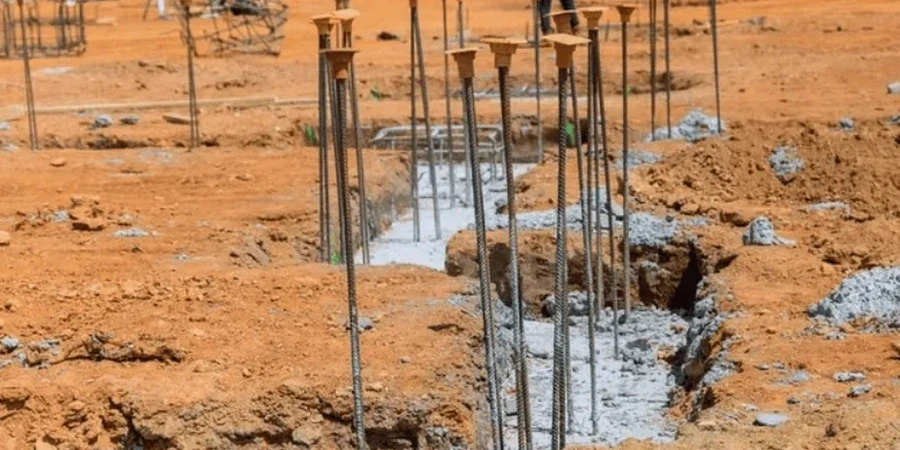
The selection of a foundation type is dictated by the site's soil profile, structural loads, and project scale. For single-family homes and low-rise buildings, a shallow foundation design using post-tensioned or conventionally reinforced stiffened slabs-on-grade is the most common solution, engineered to span potential soft spots and resist soil heave. In contrast, larger commercial high-rises or structures on very poor soils often necessitate deep foundations. A pile foundation design bypasses the problematic surface clays entirely, transferring loads through drilled piers or driven piles to more competent bedrock or deeper, stable strata. For heavily loaded structures like hospitals or data centers where minimizing total and differential settlement is paramount, a raft/mat foundation design creates a monolithic, heavily reinforced concrete mat that distributes loads uniformly, providing exceptional stiffness and performance.
Quick answers
Why is foundation design so critical in Dallas compared to other regions?
The Dallas area is dominated by highly expansive clay soils that undergo dramatic volume changes with moisture swings. This shrink-swell cycle can tear standard foundations apart, leading to severe cracking, sticking doors, and structural failure. A specialized design, informed by a geotechnical report, is essential to anticipate and mitigate these soil-structure interaction forces that are less prevalent in areas with stable, sandy, or rocky ground.
What are the key local building codes that govern foundation construction in Dallas?
Foundation design in Dallas must comply with the International Building Code (IBC) as amended by the city, which incorporates ASCE 7 for loads and ASCE 32 for expansive soil mitigation. For residential slabs, the Post-Tensioning Institute's DC10.5 standard is the widely accepted industry benchmark for designing post-tensioned foundations on the region's expansive clays.
How do I know which type of foundation is right for my project in North Texas?
The selection between a shallow, pile, or mat foundation is determined by a comprehensive geotechnical investigation. This report analyzes the soil's plasticity index, bearing capacity, and potential vertical rise. A structural engineer then matches the soil profile with your building's loads and performance requirements, choosing a slab-on-grade for light loads on moderate soils or deep piers for heavy structures on poor soils.
Can a properly designed foundation completely eliminate the risk of slab movement in Dallas?
While a well-engineered foundation cannot stop the soil's natural moisture-related movement, it is designed to accommodate it without distress. A stiffened slab or deep pile system isolates the structure from the moving soil, preventing differential deflection. Proper design, combined with consistent perimeter drainage and moisture maintenance, minimizes movement to tolerable levels, but the physical soil expansion itself is a natural force that cannot be entirely eliminated.