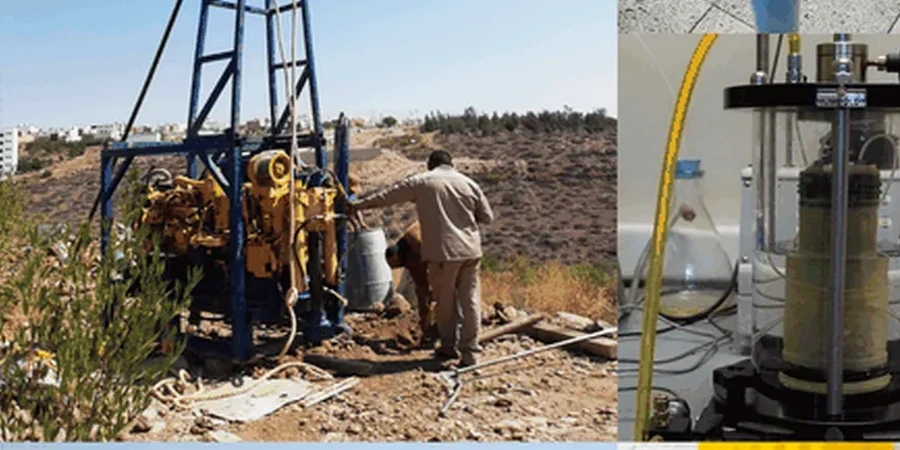
Dallas construction must comply with IBC Chapter 18 and local amendments requiring site-specific soil mechanics studies. The Eagle Ford Shale and expansive Taylor Clay formations beneath the metroplex create highly reactive soil conditions. Our AASHTO-accredited laboratory runs ASTM D1586, D2487, and D4318 protocols to characterize these units. We process Shelby tube samples from Dallas boreholes within 48 hours of extraction. Moisture content, Atterberg limits, and unconfined compression tests feed directly into foundation design parameters. For deep excavations in the downtown Dallas area, the triaxial testing program provides drained and undrained strength envelopes that prevent blowout failures in stiff fissured clays.
Expansive clay swell pressures exceeding 8 ksf are common across Dallas County. Standard penetration resistance alone does not capture this deformation potential.
Method and coverage
Site-specific factors
We often see Dallas foundation reports where the soil mechanics study stopped at SPT blow counts and moisture content. That leaves a critical gap. The Eagle Ford Shale loses 60 to 80 percent of its strength when exposed to water after excavation. Without a slake durability test and suction measurement, the contractor has no warning before the subgrade turns to slurry. Another failure pattern is underestimating the active zone depth. Dallas building officials now require moisture barriers and deep perimeter beams when the plasticity index exceeds 25 percent. Our lab reports flag these thresholds explicitly. We also recommend slope stability analysis for any cut deeper than 8 feet in the Woodbine Formation sands.
Video resource
Relevant standards
ASTM D1586-18 (Standard Penetration Test), ASTM D4318-17e1 (Atterberg Limits), ASTM D4546-21 (Swell-Consolidation), IBC 2021 Chapter 18 (Soils and Foundations), AASHTO T 99 / T 180 (Proctor Compaction)
Related services
Index Property Testing
Grain size distribution (ASTM D6913), hydrometer analysis for fines, Atterberg limits, and specific gravity on Shelby tube samples from Dallas boring locations.
Strength & Compressibility
Unconsolidated undrained (UU) and consolidated drained (CD) triaxial tests, unconfined compression, and one-dimensional consolidation for settlement predictions.
Swell & Suction Characterization
Free swell, swell pressure, and soil-water characteristic curve measurements using filter paper and chilled-mirror psychrometer methods for expansive Dallas clays.
Typical parameters
Quick answers
What is the typical cost of a soil mechanics study for a Dallas residential lot?
A complete soil mechanics study for a single-family lot within Dallas city limits runs between US$3.390 and US$4.580. This includes two borings to 20 feet, laboratory index testing, swell-consolidation, and a sealed foundation recommendation report.
How many borings does the City of Dallas require for a commercial building?
Dallas building code references IBC 1803.3.1, which mandates a minimum of one boring per 2,500 square feet of building footprint, spaced no more than 50 feet apart. For sites with variable stratigraphy, we typically add one deeper boring to penetrate the Eagle Ford Shale.
What laboratory tests are mandatory for expansive clay sites?
At a minimum, we run Atterberg limits (ASTM D4318), percent passing No. 200 sieve, and a swell-consolidation test (ASTM D4546). The Dallas amendment to IBC requires a plasticity index and swell pressure value on the foundation plan.
How do you handle groundwater encountered during the Dallas study?
We record the groundwater level at 24 hours after drilling. If perched water is present in the upper alluvium, we install a PVC observation well and return after 48 hours for a stabilized reading. This data feeds into the excavation dewatering plan.