Dallas sits on the Eagle Ford Group and Taylor Marl — stiff, overconsolidated clays that swell when wet and shrink when dry. The Plasticity Index routinely runs between 25 and 45 across the metroplex, and seasonal moisture variation penetrates 8 to 15 feet below grade. That means a spread footing or mat foundation designed without a site-specific soil report is gambling with heave, tilt, and cracked slabs. We size shallow foundations using allowable bearing pressures derived from lab consolidation tests and field SPT data, not from county-wide presumptive values. The test pits we log in neighborhoods from Bishop Arts to Lake Highlands give us the stratigraphy needed to set the bearing depth below the active zone, while companion Atterberg limits confirm the expansion potential that governs reinforcement and under-slab moisture barriers.
Allowable bearing pressure on Dallas expansive clay is not a number you pull from a table — it is a function of moisture control, foundation stiffness, and the depth of the active zone.
Method and coverage
Site-specific factors
The most common mistake we see is a contractor pouring a lightly reinforced slab-on-grade at 12 inches of embedment over unmoistened Eagle Ford clay, then walking away. Two dry summers later the perimeter settles an inch and a half, interior partition walls crack at the corners, and the owner is looking at mudjacking quotes. In Dallas, the risk is not bearing failure — it is differential heave and shrinkage. A proper shallow foundation design addresses this with a moisture-conditioned subgrade, a capillary break, and reinforcement steel sized for the expected swell pressure. We have also seen cases where fill was placed over old alluvial channels without compaction control; the footings punched through and the structure tilted. That is why our reports specify compaction criteria per ASTM D1557 and require proof-rolling or density testing before the mud slab goes in.
Relevant standards
IBC 2021 (Chapter 18 – Soils and Foundations, Section 1805), ASCE 7-22 (Minimum Design Loads and Seismic Site Classification), ASTM D1586-18 (Standard Penetration Test), ASTM D2487-17 (Unified Soil Classification System), ASTM D4318-17 (Atterberg Limits), PTI DC3.1-19 (Post-Tensioning Institute – Slab-on-Ground Design)
Related services
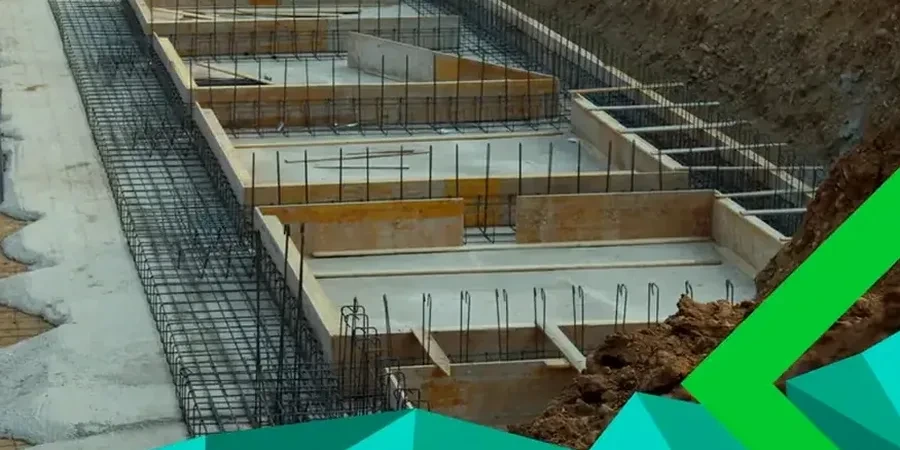
Spread Footing & Continuous Wall Footing Design
We determine footing widths and embedment depths for column and wall loads using site-specific bearing capacity equations corrected for local Dallas clay stratigraphy. Deliverables include allowable bearing pressure maps, settlement estimates under service loads, and reinforcement schedules per ACI 318.
Mat Foundation & Post-Tensioned Slab Design
For highly expansive sites or structures with sensitive finishes, we design rigid mats and PT slabs that minimize differential movement. The analysis couples geotechnical parameters from consolidation and swell tests with structural stiffness to keep angular distortion below 1/480.
Typical parameters
Quick answers
What bearing capacity can I expect for a shallow foundation on Dallas clay?
For stiff Eagle Ford or Taylor Marl with a footing embedded at least 3 feet below finished grade, we typically recommend an allowable bearing pressure between 2,000 and 3,500 psf. The exact value depends on the plasticity index, the proximity to the active zone, and the foundation rigidity. We base this on net allowable bearing pressure calculations that factor in a factor of safety of 3 against shear failure and limit total settlement to one inch.
Do I need a post-tensioned slab for a single-family home in Dallas?
In most Dallas neighborhoods with PI values above 25, a post-tensioned slab-on-grade designed per PTI DC3.1 is the standard recommendation. Ribbed PT slabs with interior stiffening beams provide the rigidity needed to span over soft spots in the active zone. The alternative — a conventionally reinforced slab — requires much thicker sections and deeper moisture barriers to achieve the same performance, and the cost difference often disappears when you factor in the long-term crack repair risk.
How deep should footings be placed to get below the active clay zone?
The active zone in Dallas typically extends 8 to 15 feet below grade, so it is rarely practical to place footings completely below it for a shallow foundation. Instead, we design for a minimum embedment of 30 inches below exterior grade (per IBC 1809.4) and control the moisture regime with positive drainage, gutters, and a capillary break. For commercial buildings on pad sites, we sometimes excavate the upper 4 to 5 feet and recompact a select fill layer to create a moisture-stable buffer.
What does a shallow foundation design package cost for a Dallas project?
For a typical residential or light commercial project in Dallas, a complete shallow foundation design package — including field investigation, lab testing, bearing capacity and settlement analysis, and a stamped report — runs between US$1,970 and US$3,380. The final figure depends on the number of borings, the lab tests required, and whether we are designing a simple spread footing layout or a full post-tensioned slab system.