ASTM D698 and D1557 form the backbone of earthwork quality control in North Texas, where the geological transition between the Eagle Ford Shale and the expansive Austin Chalk creates fill materials with widely variable compaction characteristics. In Dallas, the municipal amendments to the International Building Code require certified moisture-density relationships before any structural fill placement, a mandate that directly addresses the region's history of slab distress caused by poorly compacted clay subgrades. The Proctor test determines the maximum dry density and optimum moisture content that a soil can achieve under a specified compactive effort, values that become the contractual benchmark for nuclear gauge testing in the field. Our laboratory, accredited under ISO/IEC 17025 by A2LA, processes hundreds of Proctor curves annually for Dallas projects ranging from data center pads in Garland to mixed-use developments along the Trinity River corridor, where variable alluvial deposits demand careful compaction specification.
A one-percent deviation from optimum moisture in a Dallas fat clay can reduce compacted density by over 5 pcf, translating to significant differential movement over a slab's service life.
Method and coverage
Site-specific factors
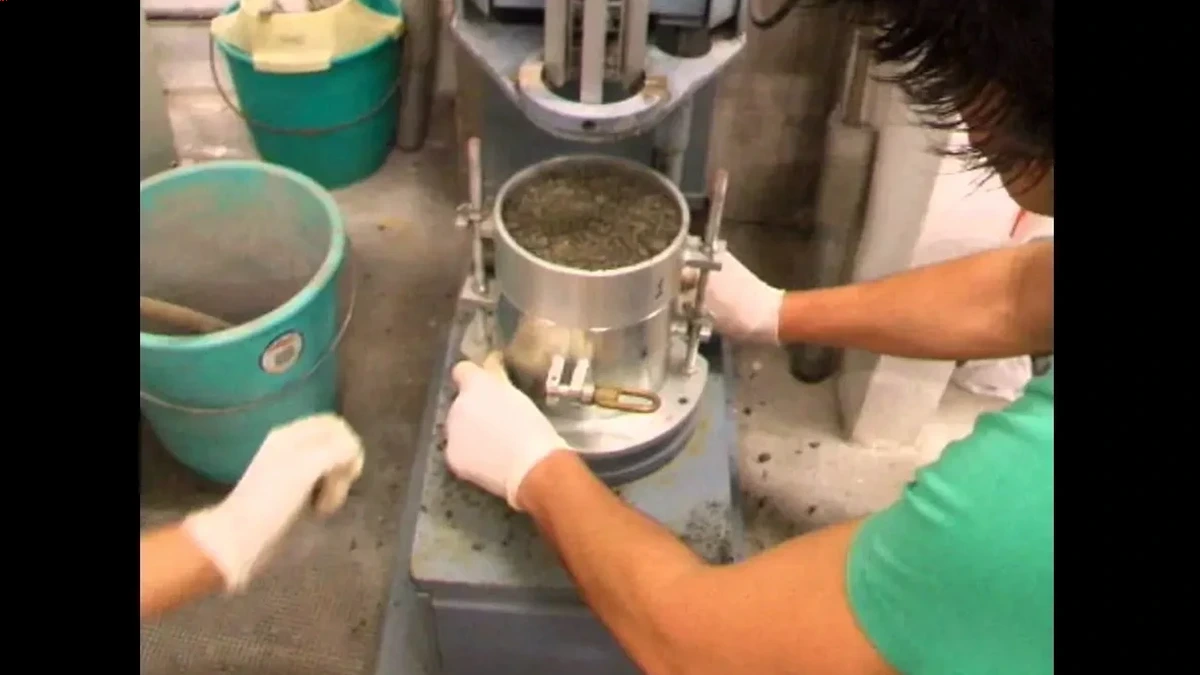
The mechanical compaction hammer used for Dallas-area Proctor testing delivers either 25 blows per layer (Standard) or 25 blows per layer (Modified) across three or five lifts, simulating the energy input of sheepsfoot rollers and vibratory compactors common on North Texas job sites. When a soil exhibits a flat Proctor curve—a frequent occurrence in the low-plasticity silty sands found in the Western Cross Timbers region west of Loop 12—the acceptable moisture range narrows considerably, and field crews must adjust water trucks with precision to avoid either under-compaction or excessive pore pressure during rolling. The real risk emerges when developers rely on a single Proctor curve for a site with multiple soil horizons; a borrow source that shifts from lean clay to fat clay across a few hundred feet will require entirely separate moisture-density relationships. Without this granularity, density acceptance testing yields false positives, and the structure inherits a subgrade prone to seasonal moisture cycling that produces the characteristic edge-lift and center-lift foundation movements well documented in the Dallas-Fort Worth metroplex.
Relevant standards
ASTM D698-12(2021) — Standard Proctor, ASTM D1557-12(2021) — Modified Proctor, ASTM D4718-15(2020) — Oversize Correction, ASTM D2216-19 — Moisture Content (oven-dry method), TxDOT Tex-113-E / Tex-114-E, IBC 2018 Section 1805 (Dallas amendments)
Related services
Standard and Modified Proctor Curves
Complete five-point moisture-density relationships using either standard or modified effort, with soil classification per USCS and AASHTO, moisture content determination per ASTM D2216, and a written engineering report that specifies the target density range and acceptable moisture window for field compaction.
Field Compaction Correlation and Oversize Correction
Laboratory one-point Proctor verification for field nuclear gauge calibration, plus ASTM D4718 oversize correction for Dallas soils containing gravel-sized shale fragments. We provide adjusted maximum dry density values that account for the coarse fraction, preventing acceptance of under-compacted fill.
Typical parameters
Quick answers
When does a Dallas project require a Modified Proctor (ASTM D1557) instead of a Standard Proctor (ASTM D698)?
The decision typically follows the project specification, but most TxDOT and commercial building pad work in Dallas mandates the Modified Proctor because its higher compactive effort (56,000 ft-lbf/ft³) better represents the energy delivered by modern vibratory rollers and heavy sheepsfoot compactors. Standard Proctor is occasionally specified for landscape fills or shallow utility trench backfill where lower energy is anticipated.
How do expansive Dallas clays affect Proctor test results?
Expansive clays from the Austin Chalk formation, with liquid limits often above 50 and plasticity indices exceeding 25, produce Proctor curves that are sensitive to small changes in molding moisture. The optimum moisture content frequently lies within 2% of the plastic limit, and compacting wet of optimum is the standard recommendation in Dallas to minimize post-construction moisture absorption and heave. Our lab reports include the plasticity index alongside the Proctor curve for this reason.
What is the typical turnaround time for a Proctor test in the Dallas area?
Standard turnaround is three to four business days from sample receipt to the final signed report. Rush processing within 24 hours is available for projects facing critical path deadlines, which is common during the summer construction season when Dallas earthwork crews operate on tight weather windows.
What does a Proctor compaction test cost for a Dallas construction project?
A single Proctor curve (Standard or Modified) generally ranges from US$100 to US$240 depending on the number of points required, whether oversize correction is needed, and the urgency of turnaround. Volume pricing applies for projects submitting multiple soil types, which is typical for Dallas sites with variable stratigraphy. More info.